



Quick Answer: The most effective way to overcome business writing challenges in large teams is structured, team-based training rather than individual services. Training teams together builds shared standards, reduces inconsistency, and addresses the root causes of poor business writing (wordiness, disorganization, and weak peer review) at an organizational level. Look for programs that combine interactive learning, real-world exercises, and a repeatable writing framework.
Improving writing at scale requires a coordinated, team-based approach, not individual training.
-
- Train teams together to build shared standards, improve collaboration, and drive consistent results
-
- Use interactive learning formats, not passive lectures, to develop real writing skills
-
- Choose programs tailored to your organization’s documents, structure, and workflows
-
- Reinforce learning with practical frameworks teams can apply immediately
The best business writing services help large teams communicate clearly, work more efficiently, and perform at a higher level.
Improving business writing at scale requires more than sending a few individuals to training.
When faced with the need to upskill a large team, piecemeal improvement won’t cut it. Building writing skills for large teams requires a coordinated, organization-wide approach that builds on shared knowledge, standards, and expectations.
So, in this situation, the most effective path forward is structured, team-based development supported by the best business writing services designed for real organizational needs.
Why does team-oriented training solve business writing challenges better than individual services?
To begin, the best business writing services for large teams emphasize team-oriented instruction. In other words, don’t scatter or silo the team into individual services. Look for workshops designed to train entire teams at once.
In fact, team training improves performance on two levels: it helps each member become a better writer and communicator, and it helps the whole team perform more effectively as a team.
Research supports this approach. Training teams together produces stronger results than training individuals in isolation. Researchers compared individual training, team training, and no training (e.g., just providing feedback that workers need to improve in a certain area) to see what produces the best outcomes. The answer: training teams together yielded the best results.
Then, training teams together will also improve team cohesion and teamwork. Or, as the researchers put it, “This study has confirmed that team-skills training facilitates effective teamwork” on work tasks.
Other research backs them up. One meta-analysis that collectively studied nearly 3,000 professional teams found that team training improves team-wide outcomes across multiple dimensions, including how well the teams acquired new skills and worked together, and what performance outcomes they generated.
In a nutshell, when teams learn together, they do more than just write better: they think better, collaborate more effectively, and execute more consistently.
We’ve found the same in our own experience teaching business writing challenges to large teams. A client might come to us looking for help with writing output, only to discover afterward that improved writing means improved internal communications too, which in turn facilitates team performance and effectiveness.
“We do a large amount of our communications via writing,” Brigitte Keon, Global Project Manager at Genentech, told us after her team completed a Hurley Write workshop, “and having the skills to communicate effectively and efficiently minimizes unnecessary frustration, confusion, misunderstanding, and delays.”
How does team training fix the consistency challenges that plague large-team business writing?
Beyond skill development, team-based training plays a critical role in building consistency and repeatability.
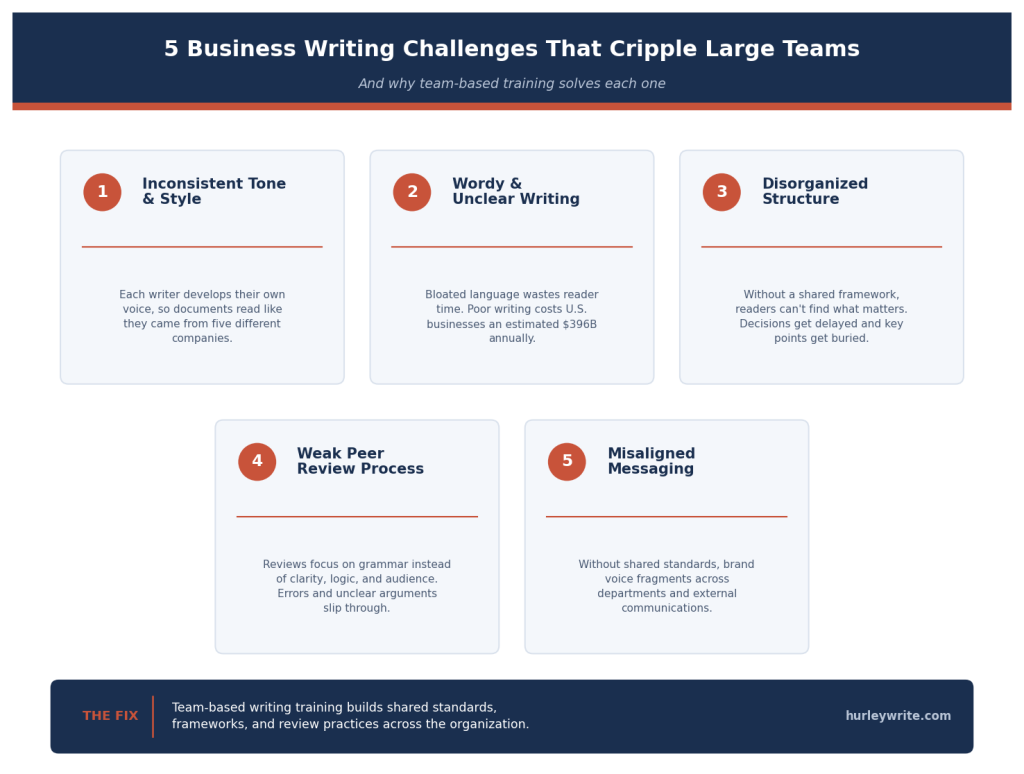
This is one of the dangers of letting large teams go untrained in critical business writing skills. Everyone undertakes each writing task differently. Each team member develops their own style, their own structure, and their own assumptions about what “good” looks like. Over time, this creates inconsistency and confusion, which in turn leads to unpredictability, delays, and errors.
Team training solves this problem by creating a shared baseline. Everyone learns the same principles, the same processes, the same standards. This makes workplace writing more consistent, more scalable, and far easier to manage across departments.
What teaching approaches actually work for large-team business writing challenges?
Having said all that, training a large group introduces a new set of logistical and pedagogical (teaching) challenges. What works for a small workshop doesn’t automatically scale. In fact, teaching techniques and formats become much more important for large teams.
“Lecturing or large group teaching is one of the oldest forms of teaching,” writes University of Galway professor Peter Cantillon. “[L]ectures are an efficient means of transferring knowledge and concepts to large groups. However, they should not be regarded as an effective way of teaching skills, changing attitudes, or encouraging higher-order thinking.”
He goes on to argue in his essay, “Teaching Large Groups,” that teaching approaches for large teams need to provide opportunities to process, critically appraise, and have some kind of participatory element to integrate the new knowledge or skills.
In other words, advanced business writing is a skill and, as a skill, requires practice, feedback, and reflection. Passive learning doesn’t produce lasting improvement. Participants need to analyze examples, apply newly learned skills, and receive feedback on their work. Breakout sessions, guided exercises, and collaborative problem-solving are essential components.
So, if you’re thinking you can just send a large team to a class, virtual or in-person, and expect maximum results, think again.
How do you choose a course that addresses your team’s specific business writing challenges?
Selecting the right training program requires careful consideration. Not all services are built to support large, complex organizations. Here’s how we recommend approaching this question:
-
- Start by examining the nature of your organization’s writing. Teams producing technical documentation, scientific reports, or highly regulated content require specialized training. A generic writing course won’t address these needs with sufficient depth.
-
- Next, assess your current writing processes. Some organizations operate without a defined approach to drafting and revision. Others have established workflows that need refinement. The right course should align with your starting point and help strengthen or build on these processes.
-
- Consider your team’s structure. A distributed workforce requires a different training approach than a fully onsite team. Virtual workshops must incorporate interactive elements that keep participants engaged across locations. In-person sessions should take advantage of real-time collaboration and group exercises.
-
- Finally, keep scalability and learning reinforcement in mind. One-time training sessions rarely produce lasting change. The most effective programs include follow-up support, practical tools, and frameworks that teams can continue using long after the course ends.
How do you build a stronger writing culture across a large team?
Improving business writing across a large team is a strategic investment in how your organization communicates, collaborates, and performs. Team-based training provides the strongest foundation: it builds shared skills, strengthens cohesion, and creates consistency at scale. Combined with interactive learning and a structured writing process, it transforms writing from a persistent challenge into a competitive advantage.
To take the next step, explore training options designed specifically for large teams or contact us for customized guidance. The right program will align with your organization’s needs and deliver measurable improvements in both writing quality and overall performance.
FAQs
Why is team-based training more effective than individual writing training?
Team-based training creates shared standards and expectations across the organization. When teams learn together, they apply the same frameworks and approaches, which improves consistency, reduces confusion, and strengthens collaboration. Individual training can improve personal skills, but it’s less likely to lead to organization-wide impact.
Do large teams need a formal writing process, or is skill training enough?
Skill development is essential, but without a clear writing process, those improvements often fade over time. The best programs also teach a structured writing process, such as the Hurley Write PROS™ framework. The process should include not just the act of writing but also planning, revising, and reviewing. Even a simple, shared process can significantly improve clarity, efficiency, and outcomes. For more information, read our explainer for “What Makes Writing Process Training Good for Teams?”
What should organizations look for in the best business writing services for large teams?
Organizations should prioritize services that are tailored to their specific writing needs, include interactive elements, and are designed to scale across large groups. The best business writing services go beyond lectures by incorporating real-world exercises, feedback, and practical frameworks that teams can use immediately. For more information about how to improve team-level communication skills, read our guide, “How Communication Workshops Help Teams.”