Industry Writing: The Writing Skills Teams Need Most in Industrial Settings

Quick Answer: Writing skills training for industrial settings builds the specific capabilities teams need to produce precise, audit-ready documents. Generic writing services focus on grammar; industry-specific training focuses on real documents like SOPs and work instructions, structured writing frameworks, compliance awareness, and clarity for multiple readers. The best programs are delivered at the team level so writing standards stay consistent across roles, reducing rework, regulatory risk, and operational miscommunication.
Industry writing is a specialized form of business writing. It requires a series of writing skills specific to industrial settings like manufacturing, engineering, biotech, and energy. Specifically, writers in industrial settings need to be able to write to multiple (and wildly divergent) readers simultaneously, flexibly adjust their writing to account for different levels of knowledge and expertise, and seamlessly meld operational effectiveness with regulatory requirements.
- Industrial documents must be precise, actionable, and audit-ready
- Generic writing training does not address these constraints
- Effective writing skills training programs focus on real documents, structured frameworks, and compliance awareness
- Team-based training ensures consistency across roles
As a result, the best industry writing skills training programs go beyond just improving writing to strengthen operations, reduce risk, and align teams around how work actually gets done.
Professional Writing in Industrial Settings Is Unlike Almost Any Other Form of Writing
Writing in fields like manufacturing, construction, engineering, architecture, biotech, energy, and similar sectors is quite different from the writing people learn in school. It is certainly different from the writing most professionals use in typical business roles.
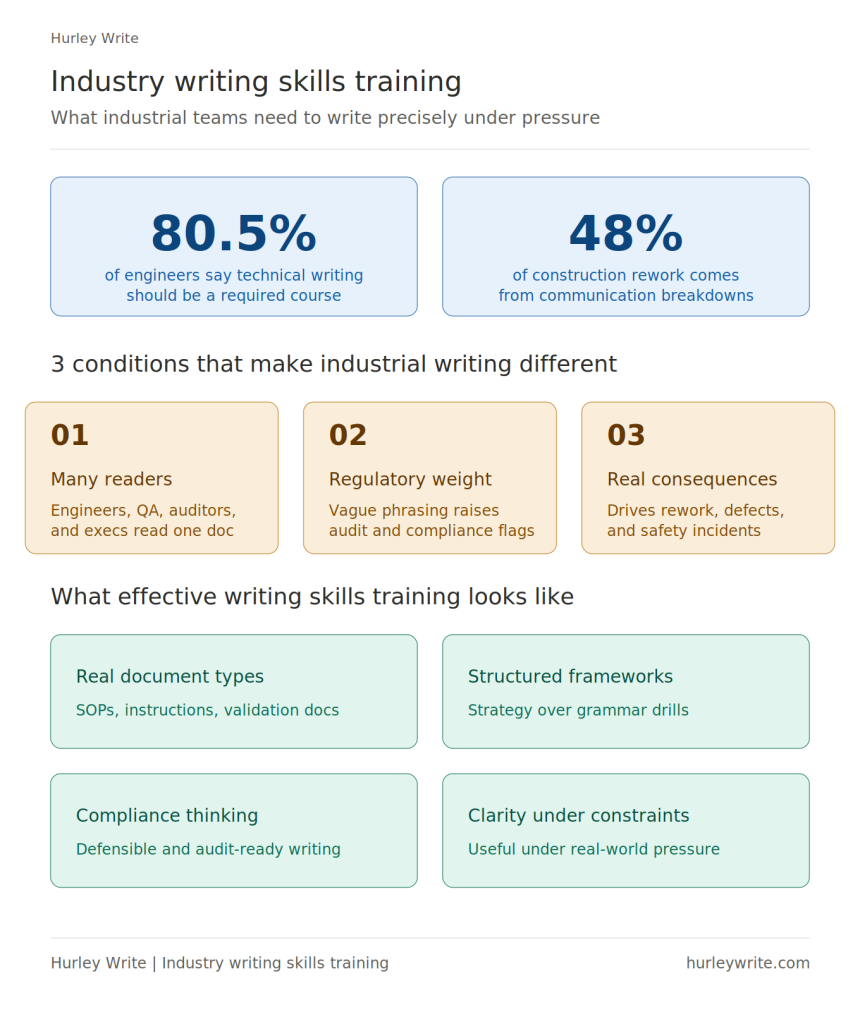
Yet in these domains, most people simply do not get the right kind of writing training, if they get any at all. That is despite 80.5% of professionals, such as engineers, saying that technical writing should at least be a required part of their undergraduate education.
That skills gap matters because the stakes of writing output are higher in industrial settings than virtually anywhere else.
Why Industrial Writing Is Different
Industrial sectors rely on writing more than most people realize. A newly graduated engineer or architect might not expect writing to be a core job function, but it is. Procedures, reports, validation documents, and work instructions all shape how work is performed, reviewed, and verified.
This writing also operates under conditions that do not exist in most business contexts.
Complex, Intersecting Readerships
In many industrial organizations, a document is not written for a single, clearly defined reader. Instead, it might be used by engineers, operators, QA teams, and others, each bringing different priorities and levels of expertise. Then add customers, investors, and non-technical executives to the mix. And do not forget regulators, auditors, safety inspectors, lawyers, and similar roles.
The need to speak to so many different groups of readers, each with wildly differing understandings of the technical material, creates a built-in tension:
- Industry writing has to be technically accurate and usable in real-world conditions.
- It has to offer the right depth of detail and be fully accessible to all its intended readers.
- It needs to be aligned with operations, but aware of relevant rules and regulations.
- Finally, it has to convey what the reader needs to know without getting lost in what the writer knows.
That last point is sometimes called the curse of knowledge: experts default to assuming readers know what they know, which produces writing that feels obvious to the author and opaque to everyone else.
A good industry writing program teaches people how to navigate that tension without diluting either meaning or clarity.
Regulatory and Legal Exposure
Many specialized industries are governed by authorities such as the US Food and Drug Administration (FDA) or the Occupational Safety and Health Administration (OSHA), and by regulatory frameworks like the International Organization for Standardization (ISO) or the Health Insurance Portability and Accountability Act (HIPAA).
Under the standards set by those authorities and frameworks, the way something is written can carry legal and compliance implications. Vague or inconsistent language can raise red flags during audits or lead to compliance failures. Written documents shift from being sources of information to forms of evidence.
That changes the nature of writing. It is no longer just about clarity. It is about defensibility, consistency, and alignment with regulatory expectations. In other words, industry writing itself becomes a form of risk management.
Operational Consequences of Miscommunication
In industrial environments, miscommunication does more than confuse. It can lead to downtime, product defects, or even safety incidents. We have explored these relationships previously, describing how bad writing causes rework in manufacturing and the costs of subpar technical writing.
In these domains, work instructions, reports, and explanatory materials must be unambiguous, structured, and easy to follow under real-world conditions. The goal is less polished prose and more reliable execution.
Why Typical Writing Skills Training Falls Short
Most writing training programs are not built for these realities.
That is because they tend to focus on general skills like grammar or conciseness, often using examples like general business emails or reports. Do not get us wrong: good grammar and succinctness are markers of solid writing.
But that kind of instruction also stops far short of what is needed. Imagine going for an engineering degree but stopping your math classes after introductory algebra. Is learning algebra crucial? Yes. Is it sufficient to get you where you need to go? Not even close.
The same is true of basic business writing services or academic writing classes. They do not teach how to write procedures that hold up under audit. They do not address compliance-driven language. And they do not prepare writers to communicate clearly in high-stakes, operational contexts.
What Makes Industry Writing Skills Training Effective
If industrial writing is different, then writing skills training has to reflect that difference. A strong program does not just improve writing in general; it builds the specific capabilities teams need to operate effectively. Look for programs that meet the following characteristics.
Built Around Real Document Types
First, effective programs focus on the documents teams actually use, such as SOPs, work instructions, validation protocols, and incident reports. The best writing workshops use live work samples, or actual documents used in the students’ workplace.
Teaches Structured Writing Frameworks
Research into writing instruction has found that grammar instruction alone has little impact on writing quality. Teaching practical writing strategies, however, produces much stronger results. Treating writing as a strategic exercise turns industry writing from a simple expression of information into a system for problem-solving.
Integrates Compliance Thinking
Writers need to understand what regulators and auditors expect. Writing skills training is not compliance training, but knowing how to incorporate compliance requirements into written documents is crucial. How do you make documentation defensible?
What creates risk in writing? How does consistency in writing style, vocabulary, and quality affect compliance outcomes? This is not typically covered in general writing services, but it is essential to think about in industrial settings.
Focuses on Clarity Under Constraints
Writing needs to be clear to a specific role, in a specific context, often under time pressure. Consider: we mentioned a relationship earlier between rework and miscommunication. In construction, for example, communication breakdowns account for 48% of all rework.
What is needed here starts but does not end with how to write clearly. Anticipating how documents will actually be used is key to ensuring they do not just sound good but are operationally effective.
Delivered at the Team Level
Perhaps most importantly, do not think of industry writing as an individual skill. From a strategic perspective, it is a team capability.
If one person writes clearly but others do not, that inconsistency still creates risk. Documents become harder to follow, harder to audit, and harder to trust. That is why the most effective writing skills training is delivered at the team level through interactive workshops designed for the intended reader. For example, engineers need writing training designed just for them.
Writing in industrial settings has unique requirements that necessitate specialized writing skills. Those skills do not appear out of nowhere, and most writing services bypass them in favor of more academic or generic writing instruction. As a result, organizations that invest in specialized writing skills training have an opportunity to gain an outright competitive advantage.
It all starts with a writing workshop designed specifically for people working in industrial settings.
Frequently Asked Questions
What does an industry writing-oriented workshop do?
An industry writing-oriented workshop teaches teams how to write the specific documents their work depends on, such as SOPs, work instructions, and technical reports. Instead of focusing on general grammar rules, it emphasizes structured writing frameworks, clarity under real-world conditions, and alignment with operational and compliance requirements. For a deeper guide, see our walk-through of technical writing workshops.
What sets effective industry writing apart in highly technical work environments?
Effective industry writing is defined by precision, clarity, and real-world usability. It must communicate complex information in a way that different roles can understand and act on without confusion. In highly technical environments, writing also carries regulatory and operational implications, so it must be consistent, defensible, and structured to support both execution and oversight. Read more about how, in highly technical workplaces, words become part of operational infrastructure.
Why should industrial organizations train teams in writing instead of individuals?
In industrial settings, writing is a shared system built out of individual skills. Documents often pass through multiple hands and must be understood across functions. If writing standards vary from person to person, it creates inconsistency, confusion, and risk. Team-based training establishes shared expectations and frameworks, leading to clearer communication and more reliable outcomes across the organization.
How long does writing skills training take to show measurable results?
Most teams see measurable improvements in document length, review time, and clarity within the first few weeks after a workshop. Sustained change comes from reinforcement, which is why effective programs build in follow-up coaching, practice assignments, and refresher modules. The combination of training plus reinforcement is what makes the improvements stick over time.
Which industries benefit most from specialized writing skills training?
Highly regulated and operationally complex industries see the largest returns. Pharma and biotech use it to produce audit-ready SOPs and deviation reports. Energy, oil, and gas teams rely on it for safety documentation. Engineering and manufacturing teams use it to reduce rework caused by ambiguous instructions. Finance, technology, and aerospace also benefit when documentation is tied to compliance or cross-functional execution.
Conclusion
Industrial writing operates under conditions that ordinary writing instruction was never designed to address: multiple readers with different expertise, regulatory scrutiny, and real operational consequences for ambiguity. Generic services leave teams short on the skills they actually need on the job.
Specialized writing skills training closes that gap. By focusing on real document types, structured frameworks, compliance thinking, and team-level consistency, it turns documentation from a downstream task into an operational asset that supports execution, reduces risk, and gives organizations a measurable advantage.