





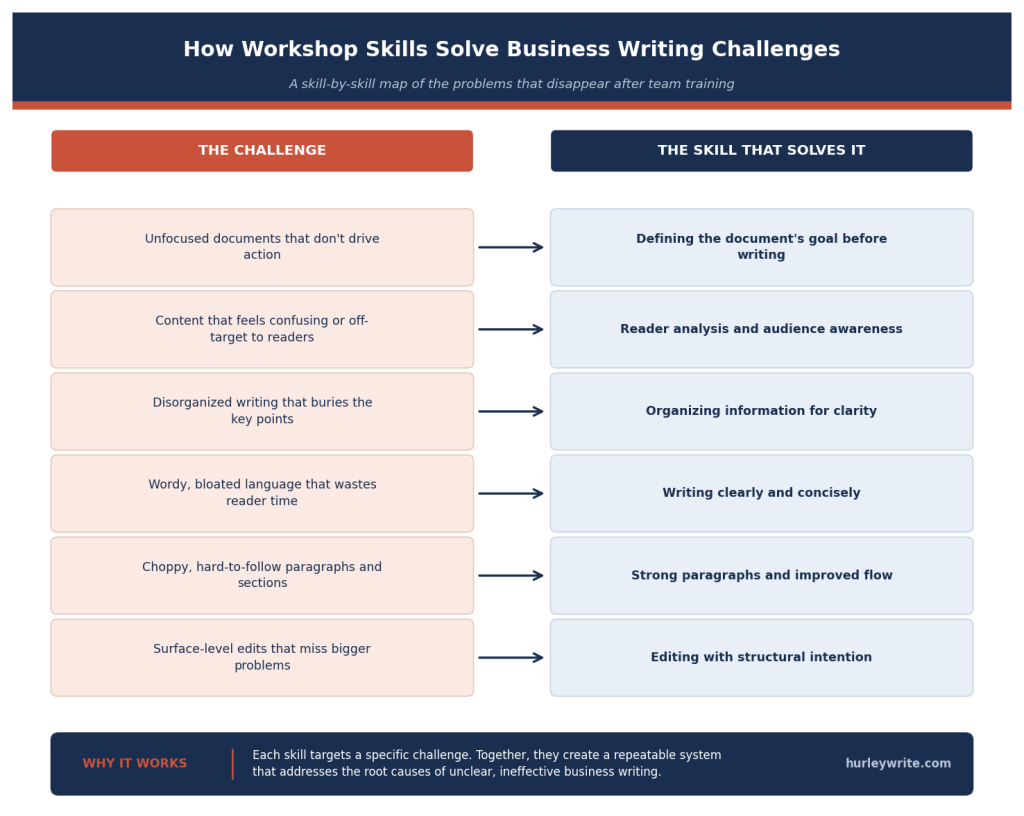
Quick Answer: Business writing workshops teach the specific skills that solve the most common business writing challenges in workplace teams: defining a document’s goal, analyzing the reader, organizing information, writing concisely, building strong paragraphs, improving flow, and editing with intention. Each skill targets a recurring problem (unclear documents, wordy language, buried key points, weak reviews) so teams stop relying on guesswork and start using a repeatable system.
Clear writing is no longer a nice-to-have skill. In today’s workplace, writing is how decisions get made, projects move forward, and trust is built across teams and with clients. Despite that, many professionals are expected to write well without ever being taught how. That gap shows up in unclear documents, slow decision-making, and constant back-and-forth communication.
This is exactly why business writing workshops exist. They focus on practical, repeatable skills that help professionals write documents that are clear, useful, and effective. The real value of business writing workshops is not just better sentences. It is the shift in how professionals think about communication and approach every document they create. Organizations that invest in structured programs like corporate writing workshops for teams often see immediate improvements in clarity, efficiency, and overall communication quality.
How does defining a document’s goal solve the most common business writing challenges?
One of the most important skills taught in business writing workshops is defining the goal of a document before writing begins. Many workplace documents fail because the writer never stops to ask what the document is supposed to accomplish. Without a clear goal, writing becomes unfocused, and readers are left to interpret the message on their own.
Business writing workshops train participants to think strategically before drafting. Writers learn how to clarify their intended outcome and align every part of the document with that goal. This reduces unnecessary content and ensures the message is focused and actionable. When writing is driven by a clear goal, documents stop being informational and start becoming functional tools that support decision-making.
Why is reader analysis the key to overcoming business writing challenges?
Another core skill developed in business writing workshops is reader analysis. Many professionals write from their own perspective, assuming their readers share the same knowledge, priorities, or context. This assumption leads to documents that feel confusing, overly detailed, or incomplete.
In business writing workshops, writers learn how to identify what their readers need, how they will use the document, and what level of detail is appropriate. This includes understanding the difference between technical and non-technical audiences and adjusting tone, structure, and content accordingly.
This reader-focused approach is central to effective communication and is reinforced in programs like writing services for professionals, where strategy and audience awareness are key. When writing is built around the reader, documents become easier to understand and more likely to drive action.
How does information organization fix the structural business writing challenges teams face most?
Strong organization is one of the defining characteristics of effective writing and a major focus of business writing workshops. Many workplace documents contain accurate information but fail because the structure makes it difficult to follow. Important points get buried, and readers have to work too hard to understand the message.
Business writing challenges teach professionals how to organize content so that ideas flow logically from one point to the next. Writers learn how to group related information, create clear sections, and guide readers toward key takeaways without confusion.
This skill matters because most readers are scanning, not reading word for word. Well-organized documents help readers quickly find what matters, which improves both efficiency and comprehension.
How do clarity and concision tackle wordiness, one of the biggest business writing challenges?
Clarity and concision are often misunderstood as writing less, but business writing workshops teach that they are about writing with precision. Many professionals use more words than necessary because they are unsure how to express their ideas clearly.
In business writing workshops, participants learn how to choose precise language, remove unnecessary filler, and structure sentences so that key ideas stand out. They also learn how to simplify complex concepts without losing meaning. This is especially important in environments where technical or detailed information must still be accessible.
These principles are closely aligned with those taught in technical writing services for professionals, where clarity and precision directly impact usability and accuracy.
What paragraph-level business writing challenges do strong workshops fix?
Paragraph-level writing is another essential skill covered in business writing workshops. Many documents struggle because paragraphs lack focus or attempt to cover too many ideas at once. This makes the writing harder to follow and weakens the overall message.
Business writing workshops help writers build paragraphs around a single clear idea and develop that idea effectively. Participants learn how to structure sentences within a paragraph so that the most important information stands out and supporting details add value rather than distraction.
Well-constructed paragraphs improve readability and allow readers to process information more efficiently, especially in longer or more complex documents.
How does flow solve the readability challenges that frustrate business readers?
Flow refers to how easily a reader can move through a document. When flow is poor, readers have to stop and interpret meaning, which slows them down and increases the chance of misunderstanding. Business writing workshops place a strong emphasis on improving flow so that documents feel cohesive and easy to follow.
Participants learn how to connect ideas between sentences and sections using transitions, headings, and logical sequencing. These techniques help guide the reader through the document without confusion or disruption.
Improved flow also strengthens the credibility of the writing. When a document reads smoothly, it feels more professional and more intentional, which increases reader confidence.
How does intentional editing address business writing challenges that surface-level reviews miss?
Editing is often misunderstood as correcting grammar, but business writing workshops take a more strategic approach. Effective editing begins with evaluating the structure, clarity, and purpose of the document before focusing on sentence-level changes.
Writers learn how to review their work by asking key questions. Does this section support the goal? Is this information necessary for the reader? Is the message clear without additional explanation? This approach leads to stronger drafts and more efficient revisions.
These skills are reinforced in programs like business writing and reviewing training programs, where editing is treated as a structured process rather than a final step.
How does goal-driven writing turn business writing challenges into measurable outcomes?
One of the most valuable skills gained from business writing workshops is understanding how writing connects directly to business outcomes. Writing is not just a way to communicate information. It influences productivity, decision-making, compliance, and client relationships.
Business writing workshops help professionals see writing as a strategic tool. When documents are clear and purposeful, teams spend less time clarifying, correcting, or rewriting. Instead, they move forward with confidence and alignment.
This shift has a measurable impact on performance. Better writing leads to faster decisions, fewer errors, and stronger collaboration across teams.
Why do these skills outlast the workshop and continue solving challenges long term?
The skills taught in business writing workshops are not quick fixes or templates for a single type of document. They are foundational skills that apply across emails, reports, proposals, and internal communication. Once learned, they can be applied repeatedly across different situations and roles.
Organizations that invest in business writing workshops see lasting improvements because teams adopt a consistent approach to communication. Writers stop guessing how to approach each document and begin using a clear, repeatable process.
Over time, this reduces wasted effort, improves alignment, and strengthens overall communication across the organization.
What is the lasting impact of business writing workshops on team-wide writing challenges?
Business writing workshops do more than improve individual performance. They create shared standards and a common language around communication. When teams use the same approach, documents become more consistent, easier to review, and more effective.
The long-term impact is a culture where writing supports work instead of slowing it down. Clear writing leads to clearer thinking, stronger decisions, and better outcomes. That is why the skills learned in business writing workshops continue to deliver value long after the training ends.
FAQs
What are the most common business writing challenges that workshops solve?
The most common business writing challenges workshops solve are unclear document goals, poor reader awareness, disorganized structure, wordiness, weak paragraphs, choppy flow, and surface-level editing. Workshops address each of these by teaching specific skills that map directly to the underlying problem, so teams stop treating symptoms (typos, formatting issues) and start solving root causes.
Can a workshop fix business writing challenges that have been around for years?
Yes. Persistent business writing challenges typically come from the absence of a shared system, not from individual skill gaps. When a team learns the same approach (goal-setting, reader analysis, structured editing), the problems that have lingered for years tend to resolve quickly because writers stop guessing and start following a process.
Are business writing challenges different in large teams versus small teams?
The challenges are similar in kind but compound at scale. In large teams, inconsistent tone, scattered structure, and weak reviews multiply across more documents and more departments, which creates higher downstream costs. For more on this, see “What’s the Best Way to Increase Business Writing Skills for Large Teams?“
How quickly do workshops produce measurable improvements in business writing challenges?
Most teams see clarity improvements within the first set of documents written after a workshop. Deeper improvements (consistency across departments, faster review cycles, fewer rewrites) build over the following weeks as the new skills become habit. Reinforcement programs and shared frameworks accelerate the timeline.