Is Your Organization Losing Opportunities Due to Poorly Written Proposals?

Quick Answer: Poorly written proposal instructions lose deals, contracts, grants, and funding rounds. The four most common failure patterns are burying the main point, padding with jargon, last-minute writing, and focusing on the seller rather than the buyer. Targeted proposal writing training fixes each one. Strong proposals are clear, reader-focused, results-oriented, requirement-compliant, engaging, and visually professional. Companies that train their proposal writers consistently win more business than those that hope individual writing talent will carry them.
Business proposals are central to operations in almost every industry. Whether your team writes sales proposals, research proposals, grant applications, or RFP responses, those documents have to be persuasive enough to convince busy readers to take the action you want.
Unfortunately, writing proposals is often one of the least favorite tasks for business developers, researchers, and engineers. It is also one of the highest stakes. When proposals win, they fund projects, close deals, and open doors. When they fail, the loss is rarely about the offer itself. It is about how the offer was written.
Better writing drives better responses: more sales, larger contracts, more funding, stronger partnerships. Despite the obvious importance of proposals, most companies leave proposal quality to whoever happens to be available, with predictable results. Proposal writing training is the single most reliable way to convert that hit-or-miss process into a repeatable competitive advantage.
What Goes Wrong in Proposal Writing
Proposal writers need to write persuasively so their documents get noticed and elicit a positive response. Writers often forget the central truth of the genre: the proposal is not about them or their company. It is for and about the people reading it.
Proposal readers are busy. They scan rather than read. They are evaluating multiple bids at once. They need to quickly understand what they are looking at so they can make a decision. When the writing forces them to work too hard, they stop working and move on to the next submission.
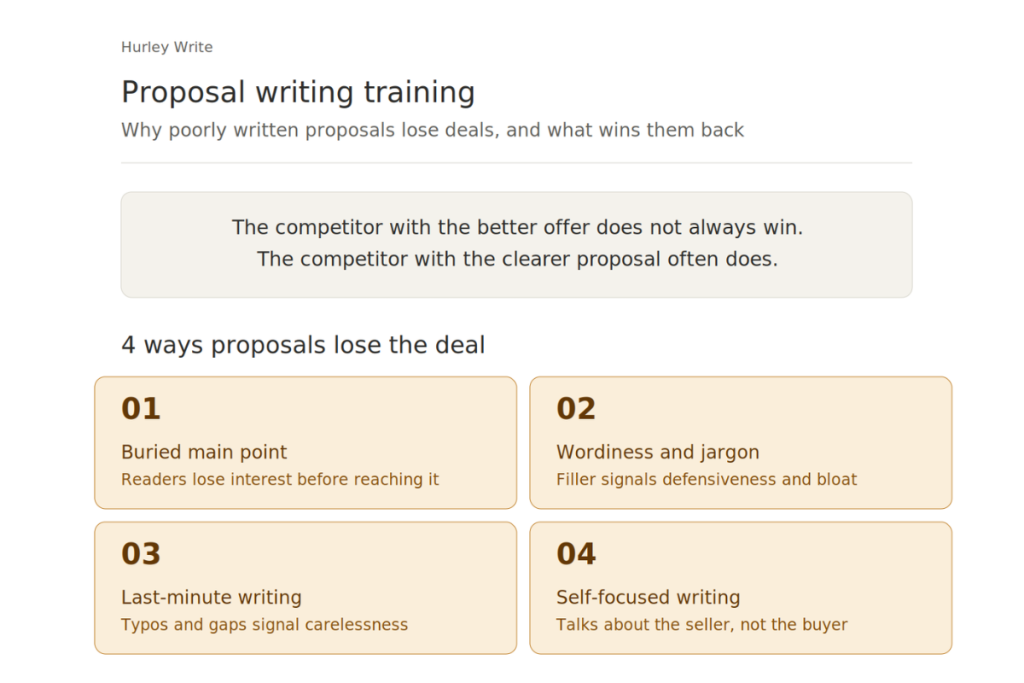
Four failure patterns explain the majority of lost opportunities:
- The main point is buried. When writers do not lead with the strongest argument, readers lose interest before they reach it.
- Wordiness and jargon dominate. Proposals padded with filler and acronyms read as dry, defensive, and self-serving.
- The writing happens at the last minute. Rushed proposals carry typos, formatting inconsistencies, and structural gaps that signal carelessness.
- The writer focuses on themselves, not the client. When proposals describe the seller’s capabilities instead of the buyer’s pain points, the buyer disengages.
Each of these is a learned habit, which means each can be unlearned through structured proposal writing training. None of them are signs of low intelligence or poor effort. They are signs of writers who have never been taught how proposal readers actually read.
What Strong Proposals Have in Common
When proposal writers receive targeted training, the work changes quickly. Strong proposals consistently share six characteristics.
They Are Clear and Direct
A strong proposal uses plain language. The main point is established immediately. The document is organized so it flows logically and supports the original premise from start to finish. Nothing is buried, nothing is hedged, and nothing requires a second reading to understand.
They Create Connections
Strong proposals connect the reader to the document by clearly tuning into the reader’s needs. They demonstrate understanding of the buyer’s situation before pitching a solution. They establish an emotional and rational link between the proposed work and the outcome the reader actually wants.
They Provide Proof of Results
Good proposals show, not just tell. They include clear evidence of the deliverable, the project, or the concept, so the reader can picture exactly what they will receive. Case studies, mockups, sample outputs, prior results, and measurable benchmarks all do this work.
They Meet the Requirements
Proposal guidelines exist for good reasons. RFPs specify page counts, font sizes, section orders, and submission formats because the buyer needs to compare bids side by side. A proposal that ignores these rules signals that the writer either did not read carefully or did not respect the buyer’s process. Both are disqualifying.
They Are Interesting
Good proposals keep the reader engaged. They tell a story with momentum. They use specific examples rather than generic claims. They avoid the tired phrasing that fills most proposals, which is part of why so many lose to less-experienced competitors with fresher writing.
They Are Aesthetically Professional
Strong proposals look like the work they describe. They follow grammar rules. They use design strategies (headings, white space, charts, callouts) when those help the reader. They demonstrate that time and care went into the document, which signals that the same time and care will go into the actual project.
Why Proposal Writing Training Pays for Itself
Good proposal writing builds the impression that your organization is professional, competent, trustworthy, and worth hiring or buying from. Without that impression, you lose sales, clients, contracts, and funding to competitors who are doing a better job representing themselves through their writing. The competitor with the better offer does not always win. The competitor with the clearer, more reader-focused proposal often does.
Research backs this up. Studies in engineering education confirm that structured writing workshops help technical professionals develop clearer documentation, strengthen logical flow, and increase effectiveness in communication. The same principles apply to proposals. Trained writers produce stronger documents in less time, with fewer review cycles, and with measurably higher win rates.
Proposal writing training is not about fixing grammar. It is about teaching writers how proposal readers think, how persuasion actually works on a busy evaluator, and how to structure a document so the right information lands in the right order. These are core skills covered in Hurley Write’s Proposal Writing workshop, which uses real workplace proposals rather than generic exercises.
For a deeper look at the underlying persuasion principles, Hurley Write’s white paper, The Art of Persuasion: The 3 Keys to Selling Your Idea Successfully, walks through how to use language as a strategic asset.
How to Tell if Your Team Needs Proposal Writing Training
Most organizations underestimate how much their proposal quality is costing them, because the losses are invisible. You see the wins. You rarely see the proposals that almost won. A few quick diagnostics:
- Win rate. If your win rate on bids you are qualified for is below industry benchmarks, the gap is usually in the writing, not the offering.
- Review cycles. If proposals routinely go through five or more internal review rounds, the underlying writing is not strong enough to anchor itself.
- Feedback patterns. If you receive feedback like “we went with someone clearer” or “your proposal was hard to follow,” the issue is documented.
- Writer confidence. If your proposal writers dread the task, their dread shows up in the document.
Any one of these is a signal that proposal writing training would pay for itself. All four together are a sign that your current process is actively costing you opportunities.
Frequently Asked Questions
How is proposal writing training different from general business writing training?
General business writing training focuses on emails, memos, and reports. Proposal writing training focuses specifically on persuasion, structure under RFP constraints, reader-focused argumentation, and the unique challenge of making complex offers easy to evaluate. The skills overlap, but the application is sharply different. A team that writes great memos can still write losing proposals.
Who on our team should attend proposal writing training?
Anyone who contributes to proposals. That usually includes business development, technical leads, project managers, and subject matter experts. Even when a single proposal coordinator owns the final document, the source material comes from many hands. If only one person is trained, the inconsistency in inputs limits how good the final output can be.
Can proposal writing training help with grant and research proposals, or just sales?
Yes to both. The fundamentals (lead with the main point, write for the reader, prove the result, meet the requirements) apply equally to sales proposals, research grants, RFP responses, and capital funding requests. The specific structure differs, but the persuasion mechanics are the same.
How quickly can we expect to see improved win rates?
Most teams see measurable improvements in the first proposal cycle after training, especially in review speed and internal confidence. Win-rate improvements typically show up within one to two quarters as the new approach is applied across multiple submissions. The longer the sales cycle in your industry, the longer the lag to see win-rate change, but the leading indicators (cleaner drafts, faster reviews, better internal feedback) appear almost immediately.
What separates a great proposal writing training program from a mediocre one?
Two things. First, the training uses your team’s actual proposals as source material, not generic templates. Second, the framework taught is structured and repeatable rather than stylistic. Programs that focus only on tone or grammar produce marginal improvements. Programs that teach a complete proposal framework, like Hurley Write’s, change how the whole team approaches the work.
Conclusion
Poorly written proposals are not a writing problem. They are a business problem. Every proposal that fails because it was buried, padded, rushed, or self-focused represents revenue, funding, or partnership that went to a competitor with clearer writing. The good news is that proposal writing is a learnable skill, and the highest-performing organizations treat it that way.
Proposal writing training transforms the work from a dreaded last-minute scramble into a repeatable system that produces stronger documents in less time. The result is more wins, faster review cycles, and a noticeable shift in how confidently your team approaches the proposal process. If your current proposals are not winning at the rate you expect, the fix is not working harder on the next one. It is teaching your team how to write the next one better.
“Studies in engineering education confirm that structured writing workshops help engineers develop clearer documentation, strengthen logical flow, and increase effectiveness in technical communication.” (Study link)
Source: Wu, S., Zha, S., Estis, J., & Li, X. (2022). Advancing Engineering Students’ Technical Writing Skills by Implementing Team-Based Learning Instructional Modules in an Existing Laboratory Curriculum. MDPI Education Sciences.