

Why Poorly Written Technical Manuals Are So Costly

Table of Contents

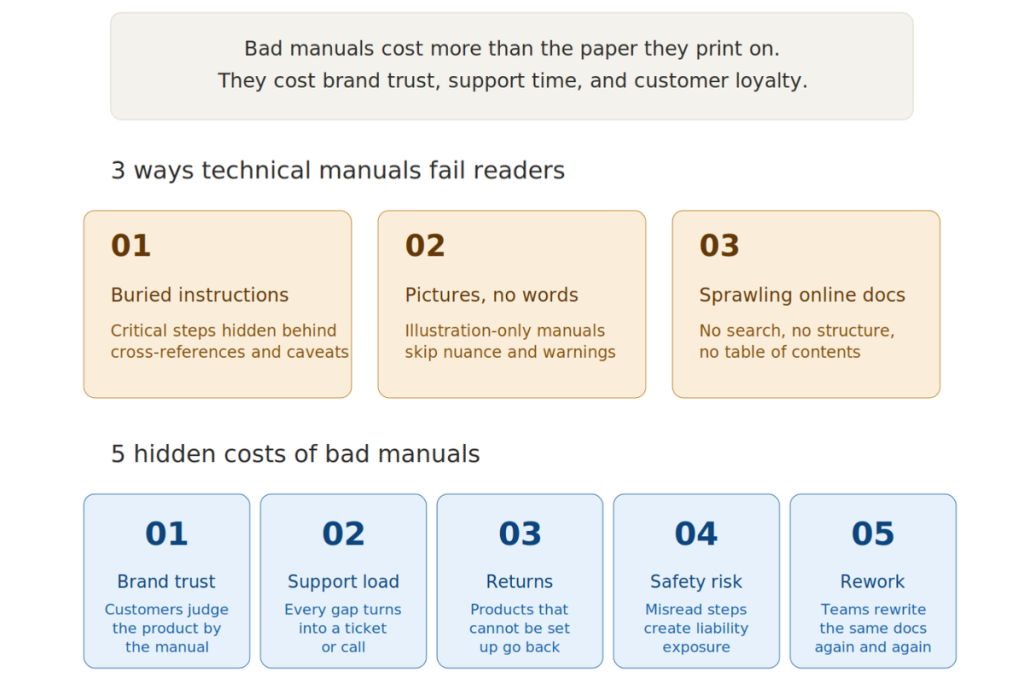
Quick Answer: Poorly written technical manuals cost companies far more than the paper they’re printed on. They damage brand trust, drive up support costs, increase product returns, and create safety and compliance risks. Three failure patterns appear in almost every bad manual: buried critical information, illustration-only instructions that omit key steps, and online-only manuals with no search or structure. Targeted writing skills training is the most reliable fix, because clear technical writing is a learned skill, not a writing-talent lottery.

As a consumer, you can tell a lot about a product from its technical manual. How a product manual is written, and even the quality of the manual itself, speak volumes about what the consumer can expect from the product. Many companies do not realize that their manual writing is an extension of the brand and image their product portrays. A confusing manual signals a confusing product. A well-written one signals confidence.

The good news is that manual quality is fixable. Companies that invest in writing skills training for their technical writers and subject matter experts consistently produce manuals that reduce support tickets, lower return rates, and protect brand reputation. The patterns below show what goes wrong when that training is missing.

Failure 1: Burying the Most Important Information

A paragraph from the technical manual for a Pentax camera reads:

“When the aperture ring is set to anything other than the A (auto) position, or a lens without an A position is used, the camera will not operate unless [22. Using the Aperture Ring] is set to [Permitted] in the [C Custom Setting 4] menu. Refer to ‘Notes on [22. Using Aperture Ring,’ (p. 314) for details.”

Did you understand that on first read? Now imagine flipping through a booklet to chase the cross-reference on page 314. Frustrating, and entirely avoidable. The critical instruction (turn on a setting before the camera will work) is buried inside two nested bracket references and a forwarded footnote.

This failure mode is one of the most common reasons companies invest in writing skills training. Subject matter experts who know their product inside out often default to writing for themselves rather than for the reader. They include every condition, every caveat, every cross-reference. The result is technically accurate and functionally useless.

Structured writing skills training teaches writers to lead with the action, then provide the conditions. The Pentax paragraph could become: “Turn on Using the Aperture Ring (Custom Setting 4) before using a manual or non-A lens. Without this setting, the camera will not operate.”

Same information. Fraction of the cognitive load.

Failure 2: Too Many Illustrations, Not Enough Text

IKEA built its global brand on illustration-only manuals. The logic was simple: pictures translate across languages, saving the company from printing manuals in dozens of localized versions.

The strategy works for simple furniture. It breaks down the moment a step requires nuance, sequencing, or warning. Without words, a manual is liable to skip key safety information, omit the order of operations, or leave the reader guessing at which screw goes where. Anyone who has assembled a piece of IKEA furniture knows the moment when the illustration is technically clear but functionally impossible to follow.

The lesson is not that illustrations are bad. They are powerful when paired with concise text. The lesson is that illustrations alone are a cost-cutting strategy that pushes the cost onto the customer in the form of frustration, time, and assembly errors. Effective technical manuals use both, and writing skills training teaches writers exactly when each tool earns its place.

Failure 3: Online-Only Manuals Without Structure

To save money, many manufacturers have moved technical manuals fully online. In principle, this is a sensible upgrade. Digital manuals can be searched, updated, and accessed from a phone. In practice, the cost savings often produce a worse product.

Because online space is essentially unlimited, manuals balloon to enormous lengths. Writers stop editing for concision because no page count is forcing them to. Then the manufacturer publishes the document as a long PDF or scrolling page with no search function, no table of contents, no anchor links, and no clear hierarchy. The reader is stuck scrolling through hundreds of screens looking for the one paragraph that matters.

A well-written online manual takes advantage of the medium. It uses search, jump links, collapsible sections, and progressive disclosure. It is shorter, not longer, than its print equivalent because digital readers scan rather than read linearly. Writing skills training that covers digital documentation teaches these instincts so writers stop treating online manuals as just longer print manuals.

The Real Cost of Poorly Written Technical Manuals

It is tempting to treat poor manuals as a minor irritation. They are not. A bad manual creates measurable cost in five places:

  • Brand perception. A confusing manual signals an unfinished product. Customers extrapolate from the manual to the company.
  • Support load. Every question the manual fails to answer becomes a support ticket, a phone call, or a returned product.
  • Return rates. Products that cannot be set up are returned, often with a one-star review attached.
  • Safety and compliance. In regulated industries, a misread instruction is a liability event waiting to happen.
  • Internal rework. Teams rewrite the same passages over and over because no one defined a writing standard upfront.

The fix is not buying better software or hiring more reviewers. The fix is teaching the people who write the manuals how to write them well. That is what professional writing skills training does.

How Writing Skills Training Prevents These Failures

Hurley Write’s approach to writing skills training treats technical writing as a problem-solving discipline, not a stylistic one. Writers learn to:

  • Identify the reader first. Every manual has multiple readers (first-time users, repeat users, technicians). Each needs different things from the document.
  • Structure for scanning. Real readers do not read manuals start to finish. They scan for the section they need. Structure has to make that scan effortless.
  • Lead with action. Critical instructions go before their conditions, not after.
  • Pair illustrations with text. Diagrams support, not replace, written instructions.
  • Edit for the medium. Print manuals are not online manuals. Each medium has its own rules.

These principles are not abstract. They are taught through hands-on work with the actual documents teams produce, which is why Hurley Write’s Exceptional Technical Writing workshop uses real workplace samples rather than generic exercises.

What Better Manuals Look Like in Practice

A well-written technical manual passes three tests. First, a new user can complete a primary task in the first five minutes without needing to ask for help. Second, an experienced user can find a specific answer in under thirty seconds. Third, a regulator or auditor reviewing the document can verify it matches the actual product behavior without ambiguity.

Manuals that pass all three are not the product of luck or natural talent. They are the product of writers who have been trained in structured writing frameworks, who understand their audience, and who have been given the time and the standards to do the work well. That training is repeatable, measurable, and well within reach for any company willing to invest.

Frequently Asked Questions

How much does a poorly written technical manual actually cost a company?

The visible costs are support tickets, returns, and reprints. The invisible costs are usually larger: damaged brand perception, lost repeat purchases, and compliance exposure in regulated industries. Companies that audit their support data after improving manual writing routinely find 20-40% reductions in product-related support volume, which translates directly into lower headcount needs and higher customer satisfaction.

Can writing skills training help subject matter experts who are not professional writers?

Yes, and this is often where the biggest gains come from. Most technical manuals are written by engineers, scientists, or product specialists rather than dedicated writers. Writing skills training designed for technical professionals teaches them to translate expert knowledge into reader-friendly instructions without losing accuracy. This is exactly the gap Hurley Write’s industry-specific workshops are built to close.

Why do illustration-only manuals so often fail?

Illustrations are excellent for showing spatial relationships and sequence, but they struggle with conditions, warnings, and exceptions. A picture cannot easily say “do this unless X is true.” When manuals rely on illustrations alone, they end up omitting the nuance that determines whether a user succeeds or fails. The solution is not abandoning illustrations but pairing them with brief, precise written instructions.

What is the difference between technical writing and writing skills training?

Technical writing is the output. Writing skills training is how teams learn to produce that output consistently. Good writing skills training covers structure, audience analysis, clarity techniques, and document-specific frameworks for things like SOPs, work instructions, and manuals. It is the difference between hoping for good documents and engineering them.

How long does it take to see improvements after writing skills training?

Most teams see measurable improvements in their next document cycle. Manuals get shorter, review cycles get faster, and reader-facing complaints drop. Sustained improvement comes from reinforcement: practice assignments, peer review using the new framework, and refresher modules. The combination of training plus reinforcement is what turns a single workshop into a permanent capability.

Conclusion

Poorly written instructions are not a minor formatting issue. They cost real money in support, returns, and brand damage, and in regulated industries, they create genuine risk. The three failure patterns above (buried information, illustration-only instructions, and structureless online manuals) show up in nearly every bad manual on the market.

The cause is rarely effort or intelligence. It is the absence of structured writing skills training. Companies that invest in teaching their technical writers, engineers, and subject matter experts how to write for the reader produce manuals that are shorter, clearer, and measurably more effective. Hurley Write’s technical writing workshops are built specifically for this purpose, using real workplace documents and proven frameworks to turn technical experts into clear communicators.

Why Poorly Written Technical Manuals Are So Costly

Table of Contents

Quick Answer: Poorly written technical manuals cost companies far more than the paper they’re printed on. They damage brand trust, drive up support costs, increase product returns, and create safety and compliance risks. Three failure patterns appear in almost every bad manual: buried critical information, illustration-only instructions that omit key steps, and online-only manuals with no search or structure. Targeted writing skills training is the most reliable fix, because clear technical writing is a learned skill, not a writing-talent lottery.

As a consumer, you can tell a lot about a product from its technical manual. How a product manual is written, and even the quality of the manual itself, speak volumes about what the consumer can expect from the product. Many companies do not realize that their manual writing is an extension of the brand and image their product portrays. A confusing manual signals a confusing product. A well-written one signals confidence.

The good news is that manual quality is fixable. Companies that invest in writing skills training for their technical writers and subject matter experts consistently produce manuals that reduce support tickets, lower return rates, and protect brand reputation. The patterns below show what goes wrong when that training is missing.

Failure 1: Burying the Most Important Information

A paragraph from the technical manual for a Pentax camera reads:

“When the aperture ring is set to anything other than the A (auto) position, or a lens without an A position is used, the camera will not operate unless [22. Using the Aperture Ring] is set to [Permitted] in the [C Custom Setting 4] menu. Refer to ‘Notes on [22. Using Aperture Ring,’ (p. 314) for details.”

Did you understand that on first read? Now imagine flipping through a booklet to chase the cross-reference on page 314. Frustrating, and entirely avoidable. The critical instruction (turn on a setting before the camera will work) is buried inside two nested bracket references and a forwarded footnote.

This failure mode is one of the most common reasons companies invest in writing skills training. Subject matter experts who know their product inside out often default to writing for themselves rather than for the reader. They include every condition, every caveat, every cross-reference. The result is technically accurate and functionally useless.

Structured writing skills training teaches writers to lead with the action, then provide the conditions. The Pentax paragraph could become: “Turn on Using the Aperture Ring (Custom Setting 4) before using a manual or non-A lens. Without this setting, the camera will not operate.”

Same information. Fraction of the cognitive load.

Failure 2: Too Many Illustrations, Not Enough Text

IKEA built its global brand on illustration-only manuals. The logic was simple: pictures translate across languages, saving the company from printing manuals in dozens of localized versions.

The strategy works for simple furniture. It breaks down the moment a step requires nuance, sequencing, or warning. Without words, a manual is liable to skip key safety information, omit the order of operations, or leave the reader guessing at which screw goes where. Anyone who has assembled a piece of IKEA furniture knows the moment when the illustration is technically clear but functionally impossible to follow.

The lesson is not that illustrations are bad. They are powerful when paired with concise text. The lesson is that illustrations alone are a cost-cutting strategy that pushes the cost onto the customer in the form of frustration, time, and assembly errors. Effective technical manuals use both, and writing skills training teaches writers exactly when each tool earns its place.

Failure 3: Online-Only Manuals Without Structure

To save money, many manufacturers have moved technical manuals fully online. In principle, this is a sensible upgrade. Digital manuals can be searched, updated, and accessed from a phone. In practice, the cost savings often produce a worse product.

Because online space is essentially unlimited, manuals balloon to enormous lengths. Writers stop editing for concision because no page count is forcing them to. Then the manufacturer publishes the document as a long PDF or scrolling page with no search function, no table of contents, no anchor links, and no clear hierarchy. The reader is stuck scrolling through hundreds of screens looking for the one paragraph that matters.

A well-written online manual takes advantage of the medium. It uses search, jump links, collapsible sections, and progressive disclosure. It is shorter, not longer, than its print equivalent because digital readers scan rather than read linearly. Writing skills training that covers digital documentation teaches these instincts so writers stop treating online manuals as just longer print manuals.

The Real Cost of Poorly Written Technical Manuals

It is tempting to treat poor manuals as a minor irritation. They are not. A bad manual creates measurable cost in five places:

  • Brand perception. A confusing manual signals an unfinished product. Customers extrapolate from the manual to the company.
  • Support load. Every question the manual fails to answer becomes a support ticket, a phone call, or a returned product.
  • Return rates. Products that cannot be set up are returned, often with a one-star review attached.
  • Safety and compliance. In regulated industries, a misread instruction is a liability event waiting to happen.
  • Internal rework. Teams rewrite the same passages over and over because no one defined a writing standard upfront.

The fix is not buying better software or hiring more reviewers. The fix is teaching the people who write the manuals how to write them well. That is what professional writing skills training does.

How Writing Skills Training Prevents These Failures

Hurley Write’s approach to writing skills training treats technical writing as a problem-solving discipline, not a stylistic one. Writers learn to:

  • Identify the reader first. Every manual has multiple readers (first-time users, repeat users, technicians). Each needs different things from the document.
  • Structure for scanning. Real readers do not read manuals start to finish. They scan for the section they need. Structure has to make that scan effortless.
  • Lead with action. Critical instructions go before their conditions, not after.
  • Pair illustrations with text. Diagrams support, not replace, written instructions.
  • Edit for the medium. Print manuals are not online manuals. Each medium has its own rules.

These principles are not abstract. They are taught through hands-on work with the actual documents teams produce, which is why Hurley Write’s Exceptional Technical Writing workshop uses real workplace samples rather than generic exercises.

What Better Manuals Look Like in Practice

A well-written technical manual passes three tests. First, a new user can complete a primary task in the first five minutes without needing to ask for help. Second, an experienced user can find a specific answer in under thirty seconds. Third, a regulator or auditor reviewing the document can verify it matches the actual product behavior without ambiguity.

Manuals that pass all three are not the product of luck or natural talent. They are the product of writers who have been trained in structured writing frameworks, who understand their audience, and who have been given the time and the standards to do the work well. That training is repeatable, measurable, and well within reach for any company willing to invest.

Frequently Asked Questions

How much does a poorly written technical manual actually cost a company?

The visible costs are support tickets, returns, and reprints. The invisible costs are usually larger: damaged brand perception, lost repeat purchases, and compliance exposure in regulated industries. Companies that audit their support data after improving manual writing routinely find 20-40% reductions in product-related support volume, which translates directly into lower headcount needs and higher customer satisfaction.

Can writing skills training help subject matter experts who are not professional writers?

Yes, and this is often where the biggest gains come from. Most technical manuals are written by engineers, scientists, or product specialists rather than dedicated writers. Writing skills training designed for technical professionals teaches them to translate expert knowledge into reader-friendly instructions without losing accuracy. This is exactly the gap Hurley Write’s industry-specific workshops are built to close.

Why do illustration-only manuals so often fail?

Illustrations are excellent for showing spatial relationships and sequence, but they struggle with conditions, warnings, and exceptions. A picture cannot easily say “do this unless X is true.” When manuals rely on illustrations alone, they end up omitting the nuance that determines whether a user succeeds or fails. The solution is not abandoning illustrations but pairing them with brief, precise written instructions.

What is the difference between technical writing and writing skills training?

Technical writing is the output. Writing skills training is how teams learn to produce that output consistently. Good writing skills training covers structure, audience analysis, clarity techniques, and document-specific frameworks for things like SOPs, work instructions, and manuals. It is the difference between hoping for good documents and engineering them.

How long does it take to see improvements after writing skills training?

Most teams see measurable improvements in their next document cycle. Manuals get shorter, review cycles get faster, and reader-facing complaints drop. Sustained improvement comes from reinforcement: practice assignments, peer review using the new framework, and refresher modules. The combination of training plus reinforcement is what turns a single workshop into a permanent capability.

Conclusion

Poorly written instructions are not a minor formatting issue. They cost real money in support, returns, and brand damage, and in regulated industries, they create genuine risk. The three failure patterns above (buried information, illustration-only instructions, and structureless online manuals) show up in nearly every bad manual on the market.

The cause is rarely effort or intelligence. It is the absence of structured writing skills training. Companies that invest in teaching their technical writers, engineers, and subject matter experts how to write for the reader produce manuals that are shorter, clearer, and measurably more effective. Hurley Write’s technical writing workshops are built specifically for this purpose, using real workplace documents and proven frameworks to turn technical experts into clear communicators.

Discover Better Writing

Find the perfect writing course. Start typing to search.

Contact Hurley Write, Inc.

We’re here to help your team communicate better. Let us know how to reach you.

Prefer to chat? Call us at 877-249-7483

Prefer to chat? Call us at 877-249-7483