


Is It Possible To Over-Communicate In A Writing Project?

Table of Contents

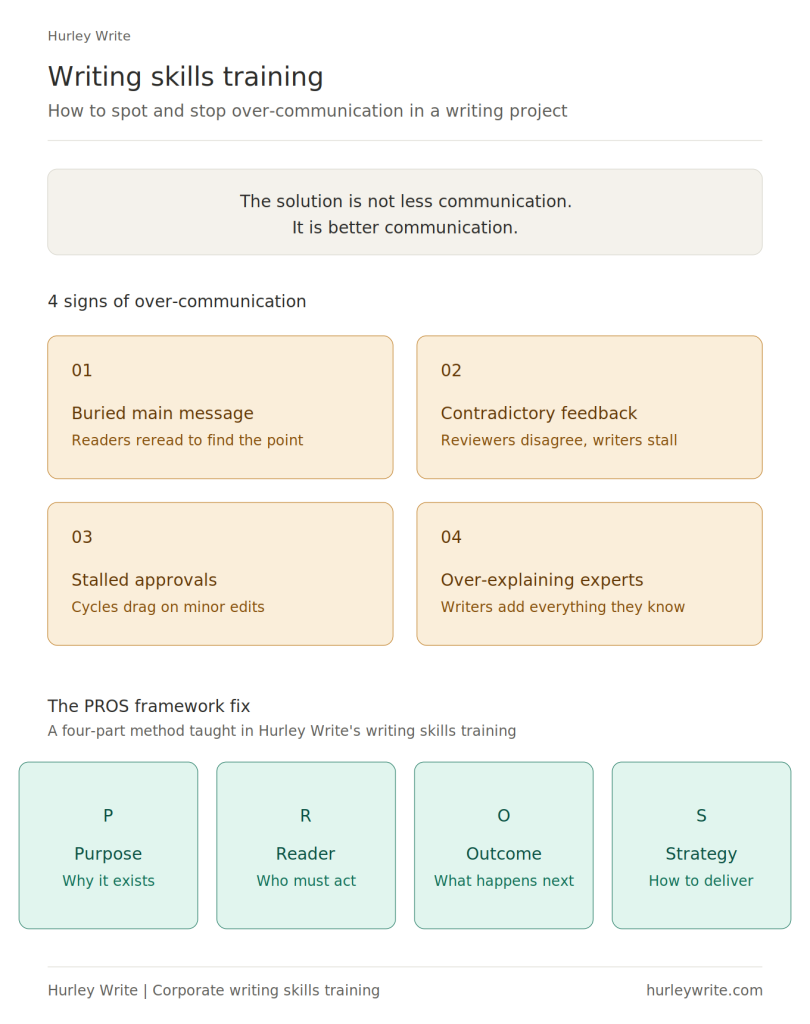
Quick Answer: Yes, you can over-communicate in a writing project, and training in writing skills is the most direct way to fix it. Over-communication happens when documents are stuffed with excess detail, contradictory feedback, or unfocused messaging that buries the main point. The solution is not less communication but better communication: clear purpose, defined audience, and disciplined editing. Targeted writing skills training gives teams the tools to prioritize, organize, and refine content so every sentence earns its place.

A writing project is often seen as a space where more communication is always better. Teams are encouraged to share updates, provide feedback, and document every detail to ensure nothing is missed. While this approach comes from a good place, it can create an unexpected problem. Over-communication in a writing project can be just as damaging as poor communication, and it is one of the most common issues structured writing skills training is built to solve.

Over-communication happens when a writing project becomes overloaded with unnecessary information, excessive feedback, or unclear messaging. Instead of improving clarity, it creates noise. Readers struggle to identify what matters, writers lose focus, and the project slows down. In many cases, the issue is not the amount of communication itself but the lack of strategy behind it.

Hurley Write’s approach to professional communication highlights that effective writing is not about saying more. It is about saying the right things in the right way for the intended reader. When a writing project lacks this focus, even well-intentioned communication can lead to confusion.

Why More Communication Is Not Always Better in a Writing Project

It is easy to assume that adding more detail will improve a writing project. After all, more information should mean fewer questions. In reality, the opposite is often true.

When a writing project includes too much information, readers have to work harder to find the key message. Important points get buried under secondary details, and the overall purpose becomes unclear. This can lead to delays, misinterpretation, and repeated revisions.

In many organizations, writing projects suffer because writers try to include everything they know. This approach creates documents that are long, unfocused, and difficult to use. Hurley Write emphasizes that documents should be targeted and concise, focusing only on what the reader needs to achieve the desired outcome.

A writing project that prioritizes clarity over volume will always be more effective than one that overwhelms the reader.

The Impact of Over-Communication on Clarity

Clarity is the foundation of any successful writing project. Without it, even the most accurate information loses its value. Over-communication directly undermines clarity by introducing unnecessary complexity, which is exactly the habit that writing skills training is designed to break.

When a writing project becomes overloaded, sentences grow longer, paragraphs lose structure, and the document becomes harder to follow. Readers may need to reread sections multiple times to understand the message. In high-stakes environments like pharma, energy, and engineering, this can create serious risks.

Strong writing skills help prevent this issue by encouraging writers to simplify complex ideas. Instead of adding more content, they focus on refining what is already there. This includes choosing precise language, organizing information logically, and removing anything that does not support the main goal.

Hurley Write teaches that readability is critical. Documents should align with how readers process information, not how writers prefer to present it. This shift is essential for maintaining clarity in any writing project.

How Does Over-Communication Slow Down a Writing Project?

A writing project that suffers from over-communication often becomes inefficient. What starts as an effort to improve collaboration can quickly turn into a cycle of endless revisions and feedback.

When too many voices are involved without a clear structure, feedback can become inconsistent or even contradictory. Writers may receive comments that focus on personal preferences rather than the needs of the reader. This leads to confusion and forces the writer to make unnecessary changes.

Hurley Write has identified that many organizations struggle with review processes that waste time without improving documents. A communication diagnostic often reveals the root cause: a lack of clear guidelines and strategy. When a writing project is not guided by a defined purpose, communication becomes scattered and unproductive.

By streamlining communication and focusing on meaningful feedback, teams can reduce revision cycles and improve efficiency.

The Role of the Audience in Preventing Over-Communication


One of the most effective ways to avoid over-communication in a writing project is to focus on the audience. Every document should be written with a clear understanding of who will read it and what they need.

When writers do not consider their audience, they tend to include too much information. They try to cover every possible detail, which leads to cluttered and unfocused content. On the other hand, when the audience is clearly defined, it becomes easier to decide what to include and what to leave out.

Hurley Writes’ PROS framework emphasizes the importance of purpose, reader, outcome, and strategy. This approach helps writers create targeted documents that meet the needs of their audience without unnecessary content.

In a writing project, understanding the audience is the key to balancing communication. It ensures that the document is informative without being overwhelming.

Finding the Balance in a Writing Project

The goal of any writing project is not to minimize communication but to make it effective. This requires a balance between providing enough information and avoiding unnecessary detail.

Effective communication in a writing project is intentional. Every sentence, paragraph, and section should serve a purpose. Writers should ask themselves whether each piece of information helps the reader achieve the desired outcome. If it does not, it should be removed.

This approach also applies to feedback and collaboration. Teams should focus on providing comments that improve clarity, logic, and usability. Feedback that does not contribute to these goals should be avoided.

Hurley Writes’ corporate writing training for employees focuses on helping professionals develop strategies for planning and organizing their documents. By applying these strategies, teams can create writing projects that are both efficient and effective.

Writing Skills Training That Prevents Over-Communication

Targeted writing skills training plays a critical role in preventing over-communication in a writing project. The right training enables writers to communicate more with less.

One key skill is the ability to prioritize information. Writers must identify the most important points and present them clearly. This requires critical thinking and a deep understanding of the document’s purpose, which is a core focus of effective writing skills training.

Another important skill is organization. A well-structured writing project guides the reader through the content in a logical way. This reduces the need for additional explanation and makes the document easier to follow.

Editing is also essential. Writers should review their work to eliminate redundancy, improve clarity, and ensure consistency. This process helps refine the document and remove any unnecessary content.

Hurley Write emphasizes that writing is a problem-solving activity. By approaching a writing project with a strategic mindset, professionals can create documents that are clear, concise, and effective. That mindset is built through hands-on practice, individualized feedback, and the kind of structured writing skills training that goes beyond surface-level grammar rules.

When More Communication Is Necessary in a Writing Project

While over-communication can be a problem, there are situations where additional communication is necessary. Complex writing projects, especially in regulated industries, may require more detail to ensure accuracy and completeness.

The key difference is that effective communication is purposeful. It adds value and supports the reader’s understanding. Over-communication, on the other hand, adds noise without improving clarity.

In writing skills training, the goal should always be to communicate enough to achieve the desired outcome. This means providing the right level of detail, using clear language, and organizing information effectively.

By focusing on purpose and audience, writers can determine when more communication is needed and when it is not.

Conclusion

It is absolutely possible to over-communicate in a writing project. While communication is essential, too much of it can create confusion, slow down progress, and reduce the effectiveness of the final document.

The solution is not to communicate less but to communicate better. Strong writing skills training, a clear understanding of the audience, and a strategic approach to content creation are all essential for achieving this balance. Teams that invest in professional writing skills training consistently produce documents that are tighter, clearer, and faster to approve.

A successful writing project delivers the right message in the right way. It is clear, concise, and focused on the reader’s needs. By avoiding over-communication and prioritizing clarity, teams can create documents that drive results and support better decision-making.

Frequently Asked Questions

How do I know if my team is over-communicating in a writing project?

Look for documents that require multiple readings to understand, review cycles that yield contradictory feedback, and approvals that stall on minor details rather than on substance. If subject matter experts feel pressure to “add everything they know” instead of writing for a defined reader, the team is over-communicating. Writing skills training that focuses on audience and purpose is the fastest way to reset that pattern.

Does over-communication only happen in technical or regulated writing?

No. It shows up in proposals, internal memos, marketing copy, board reports, and customer-facing emails. Any time a writer is uncertain about the reader or the purpose, they tend to over-explain. Regulated industries see it more visibly because the stakes are higher, but the underlying habit is universal across business writing.

Can writing skills training fix over-communication if my team has been writing the same way for years?

Yes, but only if the training is built around real workplace documents rather than generic exercises. Long-standing habits change when professionals see their own writing analyzed against a clear framework, get feedback from an expert, and practice the new approach on documents they actually produce at work.

What is the difference between thorough writing and over-communication?

Thorough writing includes every detail the reader needs to act, decide, or comply. Over-communication includes details that the writer wants to share that the reader does not need. The test is simple: if removing a sentence would not affect the reader’s ability to achieve the outcome, the sentence is over-communication.

How long does it take to see results from writing skills training?

Most teams see measurable improvements in document length, review time, and clarity within the first few weeks after a workshop. Longer-term retention requires reinforcement, which is why Hurley Write builds follow-up coaching, practice assignments, and refresher modules into its programs. The combination of training plus reinforcement is what makes the change stick.

Is It Possible To Over-Communicate In A Writing Project?

Table of Contents

Quick Answer: Yes, you can over-communicate in a writing project, and training in writing skills is the most direct way to fix it. Over-communication happens when documents are stuffed with excess detail, contradictory feedback, or unfocused messaging that buries the main point. The solution is not less communication but better communication: clear purpose, defined audience, and disciplined editing. Targeted writing skills training gives teams the tools to prioritize, organize, and refine content so every sentence earns its place.

A writing project is often seen as a space where more communication is always better. Teams are encouraged to share updates, provide feedback, and document every detail to ensure nothing is missed. While this approach comes from a good place, it can create an unexpected problem. Over-communication in a writing project can be just as damaging as poor communication, and it is one of the most common issues structured writing skills training is built to solve.

Over-communication happens when a writing project becomes overloaded with unnecessary information, excessive feedback, or unclear messaging. Instead of improving clarity, it creates noise. Readers struggle to identify what matters, writers lose focus, and the project slows down. In many cases, the issue is not the amount of communication itself but the lack of strategy behind it.

Hurley Write’s approach to professional communication highlights that effective writing is not about saying more. It is about saying the right things in the right way for the intended reader. When a writing project lacks this focus, even well-intentioned communication can lead to confusion.

Why More Communication Is Not Always Better in a Writing Project

It is easy to assume that adding more detail will improve a writing project. After all, more information should mean fewer questions. In reality, the opposite is often true.

When a writing project includes too much information, readers have to work harder to find the key message. Important points get buried under secondary details, and the overall purpose becomes unclear. This can lead to delays, misinterpretation, and repeated revisions.

In many organizations, writing projects suffer because writers try to include everything they know. This approach creates documents that are long, unfocused, and difficult to use. Hurley Write emphasizes that documents should be targeted and concise, focusing only on what the reader needs to achieve the desired outcome.

A writing project that prioritizes clarity over volume will always be more effective than one that overwhelms the reader.

The Impact of Over-Communication on Clarity

Clarity is the foundation of any successful writing project. Without it, even the most accurate information loses its value. Over-communication directly undermines clarity by introducing unnecessary complexity, which is exactly the habit that writing skills training is designed to break.

When a writing project becomes overloaded, sentences grow longer, paragraphs lose structure, and the document becomes harder to follow. Readers may need to reread sections multiple times to understand the message. In high-stakes environments like pharma, energy, and engineering, this can create serious risks.

Strong writing skills help prevent this issue by encouraging writers to simplify complex ideas. Instead of adding more content, they focus on refining what is already there. This includes choosing precise language, organizing information logically, and removing anything that does not support the main goal.

Hurley Write teaches that readability is critical. Documents should align with how readers process information, not how writers prefer to present it. This shift is essential for maintaining clarity in any writing project.

How Does Over-Communication Slow Down a Writing Project?

A writing project that suffers from over-communication often becomes inefficient. What starts as an effort to improve collaboration can quickly turn into a cycle of endless revisions and feedback.

When too many voices are involved without a clear structure, feedback can become inconsistent or even contradictory. Writers may receive comments that focus on personal preferences rather than the needs of the reader. This leads to confusion and forces the writer to make unnecessary changes.

Hurley Write has identified that many organizations struggle with review processes that waste time without improving documents. A communication diagnostic often reveals the root cause: a lack of clear guidelines and strategy. When a writing project is not guided by a defined purpose, communication becomes scattered and unproductive.

By streamlining communication and focusing on meaningful feedback, teams can reduce revision cycles and improve efficiency.

The Role of the Audience in Preventing Over-Communication


One of the most effective ways to avoid over-communication in a writing project is to focus on the audience. Every document should be written with a clear understanding of who will read it and what they need.

When writers do not consider their audience, they tend to include too much information. They try to cover every possible detail, which leads to cluttered and unfocused content. On the other hand, when the audience is clearly defined, it becomes easier to decide what to include and what to leave out.

Hurley Writes’ PROS framework emphasizes the importance of purpose, reader, outcome, and strategy. This approach helps writers create targeted documents that meet the needs of their audience without unnecessary content.

In a writing project, understanding the audience is the key to balancing communication. It ensures that the document is informative without being overwhelming.

Finding the Balance in a Writing Project

The goal of any writing project is not to minimize communication but to make it effective. This requires a balance between providing enough information and avoiding unnecessary detail.

Effective communication in a writing project is intentional. Every sentence, paragraph, and section should serve a purpose. Writers should ask themselves whether each piece of information helps the reader achieve the desired outcome. If it does not, it should be removed.

This approach also applies to feedback and collaboration. Teams should focus on providing comments that improve clarity, logic, and usability. Feedback that does not contribute to these goals should be avoided.

Hurley Writes’ corporate writing training for employees focuses on helping professionals develop strategies for planning and organizing their documents. By applying these strategies, teams can create writing projects that are both efficient and effective.

Writing Skills Training That Prevents Over-Communication

Targeted writing skills training plays a critical role in preventing over-communication in a writing project. The right training enables writers to communicate more with less.

One key skill is the ability to prioritize information. Writers must identify the most important points and present them clearly. This requires critical thinking and a deep understanding of the document’s purpose, which is a core focus of effective writing skills training.

Another important skill is organization. A well-structured writing project guides the reader through the content in a logical way. This reduces the need for additional explanation and makes the document easier to follow.

Editing is also essential. Writers should review their work to eliminate redundancy, improve clarity, and ensure consistency. This process helps refine the document and remove any unnecessary content.

Hurley Write emphasizes that writing is a problem-solving activity. By approaching a writing project with a strategic mindset, professionals can create documents that are clear, concise, and effective. That mindset is built through hands-on practice, individualized feedback, and the kind of structured writing skills training that goes beyond surface-level grammar rules.

When More Communication Is Necessary in a Writing Project

While over-communication can be a problem, there are situations where additional communication is necessary. Complex writing projects, especially in regulated industries, may require more detail to ensure accuracy and completeness.

The key difference is that effective communication is purposeful. It adds value and supports the reader’s understanding. Over-communication, on the other hand, adds noise without improving clarity.

In writing skills training, the goal should always be to communicate enough to achieve the desired outcome. This means providing the right level of detail, using clear language, and organizing information effectively.

By focusing on purpose and audience, writers can determine when more communication is needed and when it is not.

Conclusion

It is absolutely possible to over-communicate in a writing project. While communication is essential, too much of it can create confusion, slow down progress, and reduce the effectiveness of the final document.

The solution is not to communicate less but to communicate better. Strong writing skills training, a clear understanding of the audience, and a strategic approach to content creation are all essential for achieving this balance. Teams that invest in professional writing skills training consistently produce documents that are tighter, clearer, and faster to approve.

A successful writing project delivers the right message in the right way. It is clear, concise, and focused on the reader’s needs. By avoiding over-communication and prioritizing clarity, teams can create documents that drive results and support better decision-making.

Frequently Asked Questions

How do I know if my team is over-communicating in a writing project?

Look for documents that require multiple readings to understand, review cycles that yield contradictory feedback, and approvals that stall on minor details rather than on substance. If subject matter experts feel pressure to “add everything they know” instead of writing for a defined reader, the team is over-communicating. Writing skills training that focuses on audience and purpose is the fastest way to reset that pattern.

Does over-communication only happen in technical or regulated writing?

No. It shows up in proposals, internal memos, marketing copy, board reports, and customer-facing emails. Any time a writer is uncertain about the reader or the purpose, they tend to over-explain. Regulated industries see it more visibly because the stakes are higher, but the underlying habit is universal across business writing.

Can writing skills training fix over-communication if my team has been writing the same way for years?

Yes, but only if the training is built around real workplace documents rather than generic exercises. Long-standing habits change when professionals see their own writing analyzed against a clear framework, get feedback from an expert, and practice the new approach on documents they actually produce at work.

What is the difference between thorough writing and over-communication?

Thorough writing includes every detail the reader needs to act, decide, or comply. Over-communication includes details that the writer wants to share that the reader does not need. The test is simple: if removing a sentence would not affect the reader’s ability to achieve the outcome, the sentence is over-communication.

How long does it take to see results from writing skills training?

Most teams see measurable improvements in document length, review time, and clarity within the first few weeks after a workshop. Longer-term retention requires reinforcement, which is why Hurley Write builds follow-up coaching, practice assignments, and refresher modules into its programs. The combination of training plus reinforcement is what makes the change stick.

Discover Better Writing

Find the perfect writing course. Start typing to search.

Contact Hurley Write, Inc.

We’re here to help your team communicate better. Let us know how to reach you.

Prefer to chat? Call us at 877-249-7483

Prefer to chat? Call us at 877-249-7483